
The Kraft Heinz M&A Machine: Deconstructing the Playbook of a Food Giant
In the global theater of mergers and acquisitions, few names evoke as much debate, analysis, and sheer gravitational pull as the serial acquirer. These are the titans of industry that grow not just organically, but through a relentless and strategic campaign of buying other companies. For M&A professionals, studying their methods is more than an academic exercise; it is a masterclass in strategy, finance, and integration, offering invaluable lessons on both triumphant execution and cautionary missteps. Among these giants, the Kraft Heinz Company stands as a particularly fascinating and complex case study. Born from one of the largest mergers in food industry history, its journey provides a rich narrative of aggressive acquisition, ruthless efficiency, and a dramatic strategic pivot that continues to reshape its formidable empire. This article deconstructs the Kraft Heinz M&A playbook, examining the machine from its core components to its future trajectory.
The Making of a Colossus
To understand Kraft Heinz’s approach to M&A, one must first understand the company itself, as its very creation was a monumental act of acquisition. The Kraft Heinz Company as we know it today was forged in the fire of a 2015 mega-merger, an approximately $49 billion deal that combined H.J. Heinz Company and Kraft Foods Group. This was no ordinary corporate marriage. The transaction was engineered by two of the most influential forces in modern capitalism: the Brazilian private equity firm 3G Capital, known for its radical operational efficiency, and Warren Buffett’s Berkshire Hathaway, the ultimate seal of long-term value investing. This parentage is the genetic code that has defined the company’s every move since.
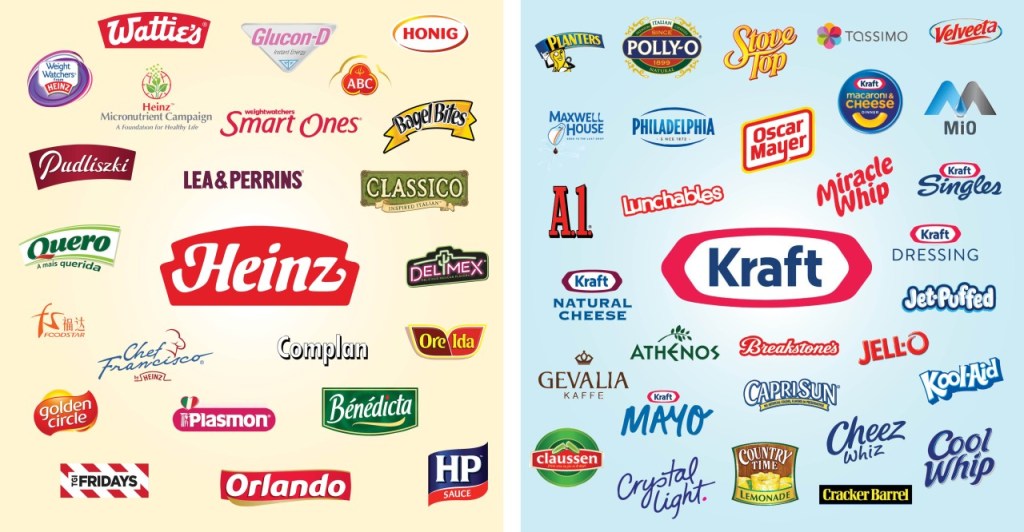
Headquartered dually in Chicago, Illinois, and Pittsburgh, Pennsylvania, Kraft Heinz operates squarely within the consumer packaged goods (CPG) sector, with a laser focus on the food and beverage industry. Its portfolio is a veritable walk through the aisles of a global supermarket, containing some of the world’s most recognizable brands, including Heinz Ketchup, Kraft Macaroni & Cheese, Oscar Mayer, Philadelphia Cream Cheese, and Jell-O. The company’s operational footprint is vast, with a presence in over 40 countries. It operates a complex network of production facilities, R&D centers, and corporate offices that span North America, Europe, Latin America, and the Asia-Pacific region, enabling it to manufacture, market, and distribute its products to consumers on a truly global scale. Kraft Heinz is not just a company that makes food; it is a global logistics and marketing machine built to feed the world.
A History Written in Deals
The acquisition history of Kraft Heinz is a tale of two distinct eras. The first era is defined by the single, cataclysmic event of its own creation in 2015. The merger of Kraft and Heinz was, in essence, the company’s foundational and largest acquisition. It was a textbook 3G Capital maneuver: take an established, somewhat sleepy giant (Kraft) and merge it with a company already under its control (Heinz), financing the deal with significant leverage and the promise of extracting massive cost synergies. The stated goal was to create an unrivaled food powerhouse with the scale and efficiency to dominate the global market. For a few years following the merger, the M&A engine was relatively quiet, as the monumental task of integrating two behemoths and relentlessly cutting costs took absolute precedence. The corporate checkbook, it seemed, was temporarily closed for major purchases.
The second era, which began roughly after the company’s dramatic 2019 writedown and subsequent strategic reassessment, is characterized by a starkly different approach. In the last five years, Kraft Heinz has shifted from a mega-merger mindset to a strategy of smaller, more targeted “bolt-on” acquisitions. The company has made only a handful of notable acquisitions in this period, a far cry from the aggressive roll-up strategies some might have initially expected. In 2021, Kraft Heinz acquired Assan Foods, a leading Turkish producer of sauces and tomato products, for approximately $100 million. That same year, it acquired a majority stake in Just Spices, a German direct-to-consumer brand specializing in innovative spice blends. Last year, the acquisition activity was minimal as the company continued its focus on internal transformation and debt reduction. This reveals a clear trend: Kraft Heinz is no longer hunting for elephants. Instead, it is selectively acquiring smaller, high-growth companies that provide specific strategic benefits, such as access to new geographies (Turkey), new channels (direct-to-consumer), or new consumer trends like “taste elevation.” This aligns perfectly with its revised corporate strategy to pivot from pure scale and cost-cutting towards a more agile, growth-oriented model.
The 3G Method: Leverage and a Laser Focus on Costs
Kraft Heinz’s acquisition methods are inextricably linked to the philosophy of its primary sponsor, 3G Capital. Historically, the company’s approach to M&A has been anything but subtle. The quintessential method, exemplified by the 2015 merger, involves a highly leveraged transaction designed to gain control and enforce a radical operational overhaul. The financing for that deal was a complex cocktail of equity from 3G and Berkshire Hathaway, a massive injection of cash, and a significant amount of new debt loaded onto the combined entity’s balance sheet. This high-leverage model creates immense pressure to generate cash flow quickly to service the debt, which in turn dictates the entire post-merger strategy. It is a high-stakes, high-reward approach that leaves very little room for error.
In its newer, more restrained M&A phase, the financing methods have become more conventional, relying on cash on hand and existing credit facilities for smaller bolt-on deals. The era of borrowing billions for transformative acquisitions appears to be on hold, a direct consequence of the debt burden the company still carries from its formation. When it comes to advisory services, a clear pattern of preferences emerges. 3G Capital has historically maintained a very close relationship with Lazard, which has served as a lead financial advisor on many of its landmark transactions, including the Heinz acquisition and the subsequent Kraft merger. Centerview Partners is another investment bank that has frequently appeared on Kraft Heinz’s deal tickets, advising on both acquisitions and, more recently, major divestitures. These relationships with a small circle of elite advisors ensure a deep understanding of the 3G playbook and an ability to execute complex, high-pressure transactions with speed and precision. While the scale of the deals has changed, the expectation for rigorous financial discipline and a clear path to value creation remains a non-negotiable part of the process.
Integration as Ideology: The Zero-Based Budgeting Doctrine
Post-merger integration (PMI) at Kraft Heinz is not merely a process; it is a core ideology. The company does not rely heavily on a sprawling internal integration office in the traditional sense, nor does it typically outsource the core integration strategy to external consultants. Instead, the integration “office” is effectively the operational arm of 3G Capital, which embeds its executives and its philosophy directly into the acquired company’s DNA. This philosophy is famously, and for some, infamously, known as Zero-Based Budgeting (ZBB). While many companies use a form of ZBB, 3G’s application of it is legendary for its purity and intensity.
Unlike traditional budgeting, where last year’s budget serves as the starting point for the next, ZBB forces every single department manager to justify every line item of their budget from a baseline of zero, every single year. This approach was the central pillar of the Kraft and Heinz integration. The goal was to obliterate any and all redundancies, inefficiencies, and “sacred cow” expenditures that had accumulated over decades. This applied to everything from corporate jet fleets and lavish marketing budgets down to the number of printers in an office. The initial results were financially stunning, delivering billions in cost savings far ahead of schedule. However, this relentless focus on cost has also been a source of intense criticism. Detractors argue that the deep cuts to R&D, marketing, and brand investment stifled innovation and eroded the long-term health of iconic brands, leaving them vulnerable to more nimble and innovative competitors. In recent years, under new leadership, Kraft Heinz has signaled a move to balance this extreme financial discipline with a renewed focus on brand building and innovation, suggesting a tacit acknowledgment that you cannot simply cut your way to sustainable growth. They may still ask managers to justify their paperclip budget, but they are also now funding the lab that might invent the next great sauce.
Strategic Pruning: The Art of the Divestiture
The M&A lifecycle is a two-way street, and for a company that began with such a massive acquisition, divestitures have become an equally critical part of its strategic toolkit. Not all assets fit the long-term vision, and some acquisitions, over time, fail to deliver on their initial promise. Kraft Heinz has become increasingly active on the sell-side, using divestitures as a key lever to reshape its portfolio, pay down its formidable debt, and sharpen its focus on higher-growth categories. The company has demonstrated a clear willingness to part with large, iconic, but slower-growing brands that no longer align with its forward-looking strategy.
The most significant divestiture in the company’s recent history was the sale of its Planters snack nuts business to Hormel Foods in 2021 for an impressive $3.35 billion. This transaction was shortly preceded by the sale of a large part of its natural cheese business to the French dairy giant Groupe Lactalis for $3.2 billion. The strategic reasoning behind these major carve-outs was twofold. First, and most urgently, the proceeds were used to de-lever the balance sheet, a top priority since the 2019 financial turmoil. Second, these sales represented a deliberate strategic pivot. Both the natural cheese and nuts businesses were mature, highly competitive, and relatively low-growth segments. By divesting them, Kraft Heinz was able to streamline its operations and free up capital and management attention to invest in its designated growth pillars: “taste elevation” platforms like sauces and condiments, convenient “easy-prep meals,” and expansion in emerging markets. Just as they have preferred advisors for buying, Kraft Heinz works with top-tier banks for selling. Centerview Partners, RBC Capital Markets, and an array of legal experts have been instrumental in structuring and executing these complex carve-outs, ensuring the company extracts maximum value while cleanly separating integrated business units.
The Future Hunt: Smaller Prey, Sharper Focus
Looking to the future, the Kraft Heinz M&A machine is unlikely to revert to the mega-deal model of its past anytime soon. The company’s leadership has been transparent about its intentions, and the strategy for the coming years appears to be one of discipline, focus, and surgical precision. The primary objective will continue to be strengthening the balance sheet and driving organic growth within its core platforms. However, M&A will remain an important tool, albeit a more specialized one. The era of the blockbuster, transformative acquisition has given way to an era of the strategic “bolt-on.”
We can expect Kraft Heinz to continue hunting for targets that fit a very specific profile. These will likely be smaller to medium-sized companies that offer one of three things: innovation, new channels, or geographic expansion. In the innovation category, targets will be brands that are leaders in emerging food trends, particularly those in the “taste elevation” space like exotic sauces, premium condiments, or unique flavorings. In terms of channels, the company will look for businesses with strong direct-to-consumer (DTC) or food service platforms that can accelerate Kraft Heinz’s own digital and out-of-home transformation. Finally, for geographic expansion, the company will seek to acquire brands that provide a strong foothold in high-growth emerging markets, following the blueprint of its Assan Foods acquisition in Turkey. The company will likely continue to prune its own portfolio as well, with perennial speculation surrounding the future of assets that may no longer be considered core, such as the Oscar Mayer meats business. The Kraft Heinz of tomorrow will be a less sprawling, more focused entity, built not through earth-shattering mergers, but through a series of intelligent, strategic additions and subtractions.
The journey of Kraft Heinz serves as a powerful, real-time case study for every M&A professional. It demonstrates the breathtaking power of a leveraged, cost-focused acquisition strategy and, simultaneously, the profound risks of prioritizing short-term efficiency over long-term brand stewardship and innovation. The company’s ongoing evolution from an aggressive acquirer to a disciplined portfolio manager offers a compelling lesson in strategic adaptation. Has Kraft Heinz truly found the right balance between financial discipline and growth, or is this new, measured approach simply a temporary period of austerity before the next big hunt begins?

 E2E Deal Insights
Leave a comment