

The Earn-Out Conundrum: Bridging Valuation Gaps and Aligning Incentives in Global M&A
In the high-stakes world of mergers and acquisitions, the valuation handshake is rarely the final word. While the headline price captures the media’s attention, the real artistry of a deal often lies hidden within its structural complexities. Among the most potent and perilous of these tools is the earn-out. It is a mechanism celebrated for its ability to bridge seemingly insurmountable valuation gaps and a source of dread for the post-close disputes it can ignite. For the seasoned M&A professional, mastering the earn-out is not just an advantage; it is a necessity for navigating the turbulent waters of modern deal-making, where uncertainty is the only certainty.
This article delves into the intricate world of earn-outs and contingent payments. We will dissect their anatomy, explore their strategic application, and illuminate the delicate balance required to harness their benefits while mitigating their risks. Moving beyond basic definitions, we will provide a rigorous framework for structuring, negotiating, and managing these powerful instruments, complete with real-world scenarios that demonstrate their application in practice. Whether you see them as a clever solution or a ticking time bomb, a deeper understanding is critical to executing successful transactions in a global marketplace.
The Anatomy of a Contingent Promise: Core Concepts and Current Trends
At its heart, an earn-out is a form of deferred consideration in an M&A transaction. It represents a portion of the purchase price that the seller will only receive if the acquired business achieves certain pre-agreed performance targets after the closing of the deal. Think of it as a performance-based bonus for the company itself. Contingent payments are a broader category that includes earn-outs but can also be tied to non-financial events, such as securing a key patent, receiving regulatory approval, or retaining a specific client. For clarity, we will focus primarily on earn-outs, as they represent the most common and complex form of contingent consideration.
The use of earn-outs tends to spike during periods of economic uncertainty or within industries characterized by high growth and volatility. When a buyer and seller have fundamentally different views on the future prospects of a business, the earn-out acts as a bridge. The seller, confident in their growth trajectory, can agree to a lower upfront payment in exchange for the opportunity to share in the future success they are so certain of. The buyer, meanwhile, mitigates the risk of overpaying for “blue-sky” projections that may never materialize. This makes earn-outs particularly prevalent in sectors like technology, life sciences, and professional services, where value is heavily dependent on intellectual property, future innovation, and human capital.
A significant trend in recent years, accelerated by global economic headwinds, is the increasing sophistication of earn-out structures. The days of simple, single-metric earn-outs based purely on top-line revenue are waning. Today’s dealmakers are crafting multi-faceted arrangements that may include a matrix of metrics such as EBITDA, gross margin, user acquisition rates, or product development milestones. This complexity aims to create a more holistic and robust measure of success, but it also exponentially increases the potential for ambiguity and disagreement down the line.
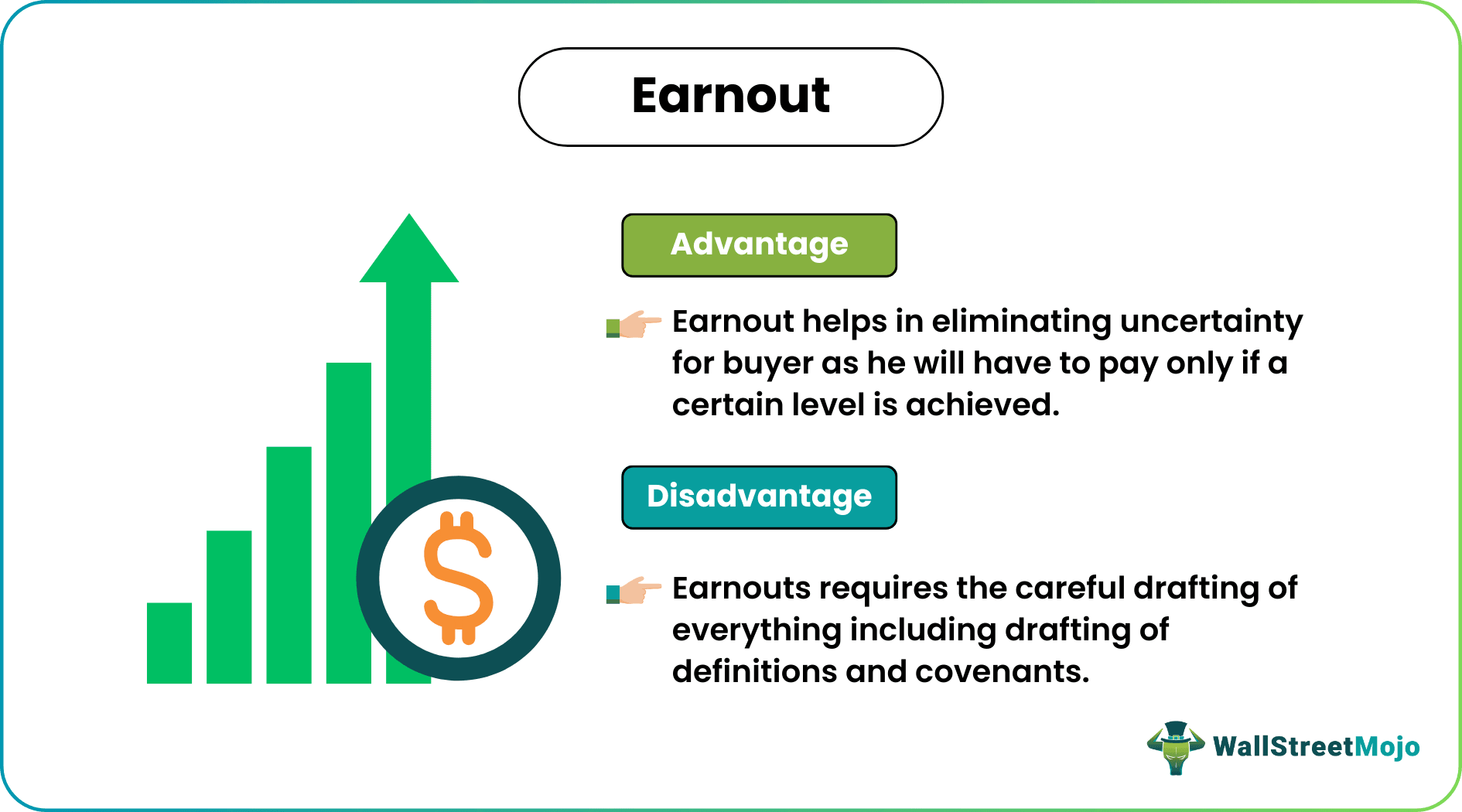
This graphic neatly summarizes the central tension of an earn-out: while it offers the advantage of mitigating a buyer’s risk by tying payment to performance, this benefit is balanced by the significant disadvantage of requiring meticulous drafting of every term to prevent future conflict.
The Three Pillars of Earn-Out Strategy
Successfully implementing an earn-out requires more than just agreeing on a target. It demands a disciplined approach built on three foundational pillars: meticulous architectural design, a clear-eyed understanding of the buyer-seller dynamic, and robust post-close governance.
Pillar 1: Architecting the Mechanism – From Metrics to Milestones
The devil is not just in the details; he is the lead architect of them. A poorly constructed earn-out is a blueprint for litigation. The primary task is to define the performance metrics with surgical precision. The chosen metrics should directly reflect the key value drivers of the business and be as objective as possible.
Common metrics include:
- Revenue: Simple and easy to track, but it can be manipulated. A seller might be tempted to chase low-margin sales to hit a revenue target, which is detrimental to the buyer’s long-term profitability.
- Gross Profit or EBITDA: A more robust measure of profitable growth, as it accounts for costs. However, this introduces complexity regarding which expenses are included, especially post-integration when shared corporate overheads come into play.
- Non-Financial Milestones: Essential for industries like biotechnology, where a company’s value might hinge on a successful clinical trial or FDA approval. These are often binary (achieved or not), which reduces ambiguity.
Beyond the metric itself, the structure must be defined without ambiguity. How is the metric calculated? The agreement must specify the accounting principles (e.g., GAAP, IFRS) and precisely how they will be applied, including any agreed-upon deviations. What is the earn-out period? A period that is too short may not capture the true performance of the business, while one that is too long can become an administrative nightmare and a prolonged source of friction. Finally, how will the payment be made? Will it be cash or stock? Will it be a “cliff” payment (all or nothing) upon hitting a single target, or a tiered structure that allows for partial payments for partial success? A tiered approach is often preferable as it maintains motivation even if the top-end target seems out of reach.
Pillar 2: The Buyer-Seller Balancing Act – Aligning Interests Without Tying Hands
An earn-out creates a unique and often fraught post-close relationship. Unlike a clean break, both parties remain financially tethered. Understanding the inherent tension from both sides of the table is crucial for negotiation and management.
From the Seller’s Perspective:
- Benefit: The primary benefit is the potential to realize a higher valuation than the buyer would otherwise offer. It allows them to be paid for the future success they believe in. It can also ensure that key members of the management team, who may be sellers themselves, remain motivated and engaged post-acquisition.
- Risk: The single greatest risk for the seller is the loss of control. After the deal closes, the buyer controls the company’s strategy, budget, and resources. A buyer could, intentionally or unintentionally, make decisions that sabotage the earn-out. For example, they might reallocate sales staff, change the product roadmap, or load the business with corporate overhead costs, all of which could depress the earn-out metric. This fear of “earn-out suppression” is the source of most seller-side disputes.
From the Buyer’s Perspective:
- Benefit: The chief benefit is risk mitigation. The buyer protects themselves from overpaying for hockey-stick projections that fail to materialize. It also serves as a powerful retention and motivation tool, ensuring that the seller’s key management, who often hold the “secret sauce” of the business, remain committed to a successful transition and integration.
- Risk: The primary risk is distraction and operational constraint. The buyer might feel that their hands are tied, unable to make sound business decisions for fear of being accused of manipulating the earn-out. The need to track, report on, and potentially debate the earn-out metrics can be a significant drain on management time. Furthermore, if the relationship sours, the very people the buyer needs to run the new business (the seller’s team) can become adversarial, poisoning the integration process from within. It can feel like inviting your former counterparty to co-pilot the plane after you’ve already bought it.
Pillar 3: Post-Close Governance – The Art of Avoiding Costly Disputes
The deal is signed, but the work has just begun. Strong post-close governance is the pillar that prevents the entire structure from collapsing into acrimony. This is where the “Dos and Don’ts” come into sharp focus.
The Essential “Dos”:
- Do define control covenants meticulously: The purchase agreement should contain specific clauses outlining how the buyer will operate the business during the earn-out period. These “covenants” might require the buyer to run the business in a manner consistent with past practice, provide adequate working capital, or not take specific actions (like selling key assets) without the seller’s consent.
- Do establish a clear process for calculation and reporting: The agreement must specify who is responsible for calculating the earn-out, when the reports are due, and what information must be provided. This transparency is non-negotiable.
- Do create an explicit dispute resolution mechanism: Hope is not a strategy. The agreement should clearly state what happens if the parties disagree on the earn-out calculation. This typically involves a period of good-faith negotiation, followed by escalation to an independent expert (like an accounting firm) for a binding determination, rather than heading straight to court.
The Critical “Don’ts”:
- Don’t use ambiguous or subjective metrics: Avoid metrics like “successful market launch” or “reasonable commercial efforts.” These are invitations to litigation. Every term must be defined.
- Don’t allow the earn-out to paralyze integration: While covenants are important, they should not prevent the buyer from achieving the synergies that justified the acquisition in the first place. This is a delicate balance, but a buyer cannot allow the earn-out “tail” to wag the strategic “dog.”
- Don’t underestimate the human element: Constant and clear communication between the buyer and the seller’s representative is paramount. Many disputes arise not from actual malfeasance but from misunderstanding, lack of information, and mistrust. Regular check-ins can defuse tension before it escalates.
Earn-Outs in the Wild: Three Case Studies in Practice
Theory is one thing; practice is another. Let’s examine three scenarios that illustrate the application of these pillars.
Case 1: The Biotech Blockbuster – A Milestone-Driven Success
Global Health Inc., a major pharmaceutical corporation, acquired Innovate BioPharma, a small firm with a promising but unproven drug in Phase II clinical trials. The valuation gap was immense. Innovate’s founders valued the company based on the drug becoming a billion-dollar blockbuster, while Global Health saw only the significant risk of trial failure.
The Structure: The deal was structured with a modest upfront cash payment and a series of substantial contingent payments tied to specific, non-financial milestones:
- A payment upon successful completion of Phase III trials.
- A larger payment upon receiving FDA approval in the United States.
- A final, significant payment upon receiving EMA approval in Europe.
The Outcome: This structure perfectly aligned incentives. Global Health was incentivized to apply its vast resources and expertise to shepherd the drug through the regulatory process to unlock its value. Innovate’s founders were rewarded directly for the scientific success of their creation, independent of post-launch sales and marketing strategies which were now out of their control. The milestones were binary and unambiguous, leaving no room for debate. The earn-out was a clear success, bridging the valuation gap and resulting in a massive win for both parties when the drug was ultimately approved.
Case 2: The Tech Integration Tangle – A Cautionary Tale
Enterprise Solutions Corp., a large, legacy software company, acquired AgileCode Inc., a fast-growing startup with a popular project management tool. The founders of AgileCode were confident they could triple revenue in two years and negotiated an earn-out based on that target.
The Structure: The earn-out was a single, large payment if AgileCode’s standalone revenue hit a specific target within 24 months. The purchase agreement included a standard covenant for the buyer to “operate the business in a manner consistent with past practice.”
The Outcome: This proved to be a disaster. Six months post-close, Enterprise Solutions integrated AgileCode’s sales team into its own massive, but slower-moving, enterprise sales force. They also rebranded the product and bundled it into a larger suite, making it nearly impossible to track “standalone revenue.” The nimble, direct-to-customer sales motion that had fueled AgileCode’s growth was dismantled in the name of synergy. The revenue target was missed by a wide margin. The sellers sued, claiming the buyer had breached the “consistent practice” covenant. The buyer countered that integration was a normal and necessary business practice. The result was years of costly litigation that destroyed any goodwill and distracted both management teams. The lesson was clear: a revenue-based earn-out is exceptionally vulnerable to integration activities.
Case 3: The SaaS Scale-Up – A Hybrid and Balanced Approach
A large private equity firm acquired CloudLeap, a mid-sized B2B SaaS company. The PE firm wanted to ensure the management team remained motivated not just to grow, but to grow efficiently and sustainably.
The Structure: The dealmakers crafted a sophisticated, multi-year earn-out with several components:
- Tiered Revenue Growth: A tiered payment schedule for achieving different levels of Annual Recurring Revenue (ARR) growth, rewarding partial success.
- Profitability Kicker: An additional bonus payment if the company also achieved a specific EBITDA margin target, discouraging “growth at all costs.”
- Retention Metric: A portion of the earn-out was tied to maintaining a net revenue retention rate above a certain percentage, ensuring that the growth was coming from happy, long-term customers, not just a leaky bucket of new sales.
The Outcome: This balanced structure proved highly effective. The management team was incentivized to pursue a holistic strategy. They couldn’t just chase new logos; they had to ensure those customers were profitable and successful. The tiered nature kept them motivated throughout the period. Because the metrics (ARR, EBITDA, Net Retention) were well-defined within the SaaS industry and the purchase agreement contained extremely detailed calculation examples, there was little room for dispute. The structure aligned the seller’s operational expertise with the buyer’s financial goals, leading to a successful exit for all involved.
The Final Verdict: Friend, Foe, or Financial Tool?
Earn-outs are neither inherently good nor bad. They are a powerful financial instrument that, like any sharp tool, can create immense value in skilled hands or cause significant damage when used carelessly. Their ability to bridge valuation gaps, de-risk acquisitions, and align incentives is undeniable. However, this power comes at the cost of complexity, risk, and the potential for post-close conflict that can poison an otherwise promising merger.
Success hinges on precision, foresight, and a mutual commitment to transparency. A well-crafted earn-out is built on unambiguous metrics, a balanced view of risks and rewards, and a robust governance framework. A poorly crafted one is little more than a deferred argument with a price tag. The most successful dealmakers recognize that an earn-out is not a substitute for rigorous due diligence or a shortcut to a valuation agreement. It is a strategic supplement, to be deployed with caution and managed with diligence.
So, when you next encounter an earn-out in a deal structure, will you see it as a bridge over a valuation gap, or a potential chasm waiting to open?
 E2E Deal Insights
Leave a comment