
Beyond the Buzz: A Deep Dive into Rentokil Initial’s Serial Acquisition Machine
In the high-stakes theater of mergers and acquisitions, the spotlight often gravitates towards the titans of tech and pharma, where multi-billion-dollar deals reshape industries overnight. We celebrate the bold, transformative single acquisition. However, a different, perhaps more disciplined, form of M&A mastery often operates just out of the limelight. This is the world of the serial acquirer, a company that has turned M&A from a sporadic, high-risk event into a continuous, strategic, and almost industrialized process. These firms build empires not through a single decisive battle, but through a sustained campaign of consistent, smaller-scale conquests.
While names like Danaher or Constellation Software are frequently cited as paragons of this model, we turn our analytical lens to a global giant in a less glamorous, yet fundamentally essential, sector: Rentokil Initial. The company provides a masterclass in how to use programmatic M&A to achieve relentless growth, market dominance, and operational efficiency. By dissecting Rentokil Initial’s playbook, from target identification to post-merger integration, we can uncover a blueprint for value creation that holds powerful lessons for M&A professionals across all industries. This article will deconstruct the engine that drives one of the world’s most prolific and successful serial acquirers.
The Unseen Empire: Who is Rentokil Initial?
Rentokil Initial plc traces its origins back to 1925 in the United Kingdom, where it was founded by an entomologist and a chemist who developed a new rodenticide. This scientific foundation has remained a core part of its identity. Today, Rentokil Initial is a global leader in business services, operating primarily in two core sectors: Pest Control and Hygiene & Wellbeing. While the work of eradicating pests or ensuring clean facilities may lack the public allure of launching a new smartphone, these services are non-discretionary, recurring, and critical for businesses worldwide, creating a highly resilient and predictable revenue stream.
The company’s headquarters is located in Camberley, UK, but its operational footprint is truly global. Rentokil Initial operates in over 90 countries, serving a diverse client base that ranges from small local restaurants to massive multinational corporations. This vast network is not just a collection of flags on a map; it is a strategically constructed web of local service depots, regional offices, and innovation centers. Their physical presence is immense, with thousands of vehicles and technicians on the ground every day, making them a visible and integral part of the commercial landscape in cities and towns from North America to Southeast Asia. This dense, local-market presence is not just a feature of their business model; it is the central pillar of their acquisition strategy.
An Insatiable Appetite: Rentokil Initial’s Acquisition History
M&A is not just a part of Rentokil Initial’s growth strategy; it is the strategy, woven into the very fabric of the company’s DNA. For decades, the company has relentlessly pursued a programmatic approach focused on acquiring small to medium-sized local businesses, often called “bolt-on” or “tuck-in” acquisitions. This long history has made the company exceptionally skilled at identifying, executing, and integrating new businesses at a pace that would overwhelm most organizations. Their M&A function operates less like a special projects team and more like a high-volume production line.
While the company is known for its steady stream of smaller deals, it made a truly transformational move in 2022 with the acquisition of its US-based rival, Terminix Global Holdings. Valued at approximately $6.7 billion, this was by far the largest acquisition in Rentokil Initial’s history. The deal dramatically scaled up its presence in North America, the world’s largest pest control market, creating an undisputed global leader. This single, massive transaction stands in stark contrast to its usual methodology but underscores the company’s ambition and strategic flexibility.
To appreciate the sheer velocity of their M&A engine, consider their recent activity. In the five years leading up to the end of 2023, Rentokil Initial completed well over 200 acquisitions. In the 2023 fiscal year alone, the company executed 41 deals, a pace of roughly one acquisition every nine days. This cadence is a testament to a highly refined and repeatable process.
The types of companies they acquire are remarkably consistent: local and regional pest control and hygiene businesses. These are often family-owned or privately-held companies with deep customer relationships and strong local reputations. This acquisition strategy aligns perfectly with the company’s core business goal of increasing market density. By acquiring a local competitor, Rentokil Initial doesn’t just gain its revenue and customer list. It absorbs the competitor’s service routes, allowing its existing technicians in the area to serve more customers within a smaller geographic radius. This densification directly translates into lower fuel costs, reduced travel time, and increased operational efficiency, driving margin expansion. The clear and consistent trend is a focus on acquiring these density-building assets in high-growth markets, particularly in North America and emerging economies, while also occasionally acquiring firms with novel technologies that can be scaled across their global network.
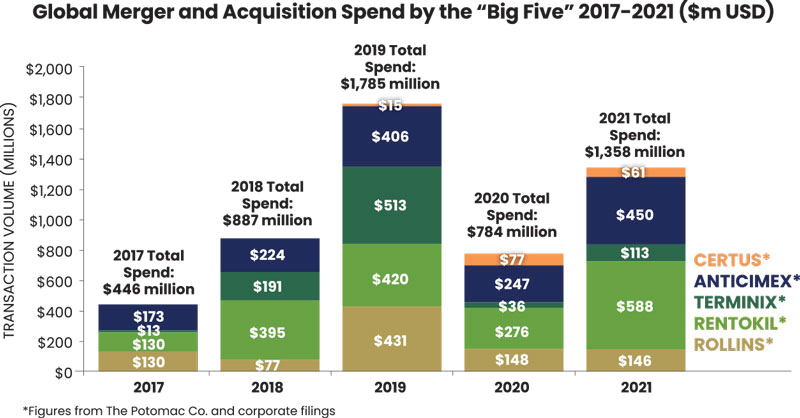
This chart visualizes the intense M&A competition among the “Big Five” pest control firms from 2017-2021, clearly positioning Rentokil Initial (light green) as a dominant serial acquirer in the years preceding its landmark acquisition of rival Terminix.
The Mechanics of the Deal: Rentokil Initial’s Acquisition Methods
Rentokil Initial employs a bifurcated approach to its acquisition methods, tailored to the size and complexity of the target. The vast majority of its deals—the bolt-on acquisitions—are executed with an efficiency that borders on an art form. These transactions are typically financed using the company’s robust operating cash flow and its revolving credit facilities. This self-funding model allows for speed and certainty, which are highly attractive to the owners of smaller businesses who often prioritize a smooth and predictable exit. For these deals, the company leverages its extensive in-house M&A team. This team, composed of experienced professionals distributed globally, manages the entire deal lifecycle from sourcing and due diligence to negotiation and closing. While local legal and financial firms are engaged for specific jurisdictional requirements, there is no single preferred global advisor for this flow of deals; the expertise is primarily internal.
The Terminix acquisition, however, represents the other side of their M&A methodology. A transaction of this magnitude required a different set of tools and partners. The financing was a sophisticated mix of new stock issuance to Terminix shareholders and cash, a structure designed to share the future upside and manage the immediate cash outlay. To navigate this complex, public-company merger, Rentokil Initial engaged a team of bulge-bracket investment banks, with Barclays and Goldman Sachs acting as lead financial advisors. This demonstrates a pragmatic understanding that while an internal team can master the high-volume bolt-on, a transformational cross-border merger demands the specialized expertise, market access, and balance sheet of top-tier external advisors. This dual approach—a highly efficient internal factory for the routine and a world-class external team for the exceptional—is a hallmark of a mature and sophisticated acquirer.
The Integration Playbook: A Well-Oiled Machine
Acquiring a company is one thing; successfully integrating it to realize value is another entirely. For a serial acquirer like Rentokil Initial, post-merger integration (PMI) is a core competency, not an afterthought. The company operates a highly developed internal integration framework, often referred to within the company as its “playbook.” This is not a rigid, one-size-fits-all manual but a dynamic set of best practices, standardized processes, and digital tools designed to bring acquired companies into the Rentokil Initial fold efficiently and effectively. This internal “integration office” function is decentralized, with dedicated teams in each major region who are experts in navigating local cultures, regulations, and business practices.
Their approach focuses on several key areas of value creation. The first priority is often to transition the acquired company onto Rentokil Initial’s IT systems, including its customer relationship management (CRM) and route-planning software. This enables immediate gains in operational visibility and efficiency. Next, they harmonize procurement to leverage their global purchasing power, reducing costs on everything from vehicles and chemicals to uniforms. Branding is another critical step, with acquired businesses typically rebranded to Rentokil or a regional power brand over a carefully managed transition period to retain local customer goodwill. Finally, they introduce best practices in service protocols, sales, and employee training. The goal is to elevate the acquired business to Rentokil Initial’s global standard while respecting and retaining the local knowledge and talent that made the company successful in the first place. It is a delicate process of harmonizing a chorus of fiercely independent local businesses into a single, powerful symphony.
For the vast majority of its bolt-on deals, this entire process is managed internally. However, for an integration of the scale and complexity of Terminix, external support is essential. In such cases, Rentokil Initial works with major management consulting and advisory firms, often from the “Big Four,” to provide additional project management horsepower, specialized functional expertise, and an objective third-party perspective to ensure the massive synergy targets are met.
Strategic Pruning: The Role of Divestitures
A truly disciplined corporate strategy involves not only knowing what to buy but also knowing what to sell. While Rentokil Initial is famous for its acquisitive nature, it is not a “buy-at-all-costs” conglomerate. The company has demonstrated a willingness to divest non-core assets to sharpen its strategic focus and reallocate capital to higher-growth opportunities. This practice of strategic pruning is a sign of a mature and unsentimental approach to portfolio management, a trait highly valued by sophisticated investors.
The most significant divestiture in Rentokil Initial’s recent history was the strategic move in 2017 involving a large part of its Workwear and Hygiene businesses in Central and Eastern Europe. Rather than an outright sale, the company entered into a joint venture with Haniel, a German family-owned conglomerate, combining these assets with Haniel’s CWS-boco business. Rentokil Initial retained a minority stake in the newly formed, larger entity.
The strategic reasoning behind this complex transaction was clear and compelling. Rentokil Initial’s leadership identified Pest Control and its Hygiene operations in growth markets as the primary engines for future value creation, offering higher margins and greater potential for market leadership. The divested European businesses, while stable, were in more mature markets and faced different competitive dynamics. By de-consolidating these assets, Rentokil Initial simplified its business, sharpened its focus on its core growth pillars, and unlocked capital that could be redeployed into its aggressive M&A program in pest control. For a transaction of this scale and cross-border complexity, the company would have relied on a team of premier investment banking and legal advisors to structure the joint venture and navigate the intricate carve-out process.
The Road Ahead: Future Acquisitions and Strategic Direction
Looking to the future, there is little reason to believe that Rentokil Initial will ease its foot off the M&A accelerator. However, the company’s near-term focus will be dominated by one monumental task: the successful integration of Terminix. Realizing the substantial cost and revenue synergies promised to investors—projected to be in the hundreds of millions of dollars—is the single most critical objective. This process will absorb significant management attention and capital for the next couple of years. The market will be watching closely to see if the company’s legendary integration playbook can be scaled up to meet a challenge of this magnitude.
Once the Terminix integration is substantially complete and the synergies are flowing, we can expect the bolt-on acquisition engine to rev back up to its full, formidable speed. The strategic logic remains as powerful as ever. The global pest control market, particularly in North America, remains highly fragmented, with thousands of small, independent operators ripe for consolidation. Rentokil Initial will continue to hunt for these density-building targets to fortify its market leadership. Furthermore, emerging markets in Asia, Latin America, and the Middle East represent vast, under-penetrated regions where the company can replicate its successful M&A-led growth model.
In terms of target types, the focus will remain squarely on pest control and, to a lesser extent, hygiene businesses. However, we may also see an increasing number of smaller, technology-focused acquisitions. Rentokil Initial is keenly aware of the potential for digital innovation to disrupt its industry. The company will likely look for targets with expertise in areas such as:
- Internet of Things (IoT) sensors for remote monitoring of traps and bait stations.
- Data analytics and artificial intelligence for predictive pest modeling and dynamic route optimization.
- Digital platforms that enhance the customer experience and streamline service delivery.
These technology “tuck-ins” will not be about buying revenue but about acquiring capabilities that can be scaled across Rentokil Initial’s global platform to create a sustainable competitive advantage for decades to come. The company has proven it can buy scale; its next challenge is to buy the future.
In conclusion, Rentokil Initial provides a compelling case study that the most effective M&A strategy is not always the one that makes the biggest splash. It is a testament to the power of discipline, focus, and a relentless, programmatic approach to value creation. By turning M&A into an industrialized core competency, the company has built a global empire in a business that is, quite literally, all around us, yet often goes unnoticed.
As the pest control and hygiene markets continue to consolidate, can Rentokil Initial’s finely-tuned M&A engine maintain its pace and discipline, or will the sheer scale of the Terminix integration force a fundamental change in its legendary playbook?
 E2E Deal Insights
Leave a comment