
The Digital Heart Transplant: A Surgeon’s Guide to Post-Merger IT Consolidation Without Flatlining Operations
In the high-stakes world of mergers and acquisitions, the deal announcement is merely the starting bell. The real marathon is the post-merger integration (PMI), a complex endeavor where anticipated synergies are either realized or lost. At the very center of this integration, pulsing with both immense potential and catastrophic risk, lies the IT systems. Integrating disparate technology stacks is less like connecting building blocks and more like performing a digital heart transplant. A successful procedure can create a streamlined, powerful entity ready for future growth. A botched one can lead to operational paralysis, data corruption, and a catastrophic loss of value, leaving the newly formed company on life support.
This article is for the seasoned M&A professional who understands that the devil is not just in the details, but in the data streams. We will dissect the strategic calculus behind IT consolidation, providing a rigorous framework for navigating this critical phase of PMI. We will move beyond the superficial checklists to explore the nuanced judgment required to decide when, what, and how to integrate. By examining practical methodologies and learning from real-world scenarios, we will equip you with the insights to lead an IT consolidation that drives value instead of disrupting the very operations you seek to improve.
Setting the Stage: The Modern M&A Digital Landscape
Before we scrub in, we must first understand the operating theater. IT system consolidation is the strategic process of evaluating, selecting, migrating, and decommissioning redundant software, hardware, and infrastructure from the merging entities into a unified, target-state technology environment. This is not just a matter of picking one ERP over another. The scope is vast, encompassing everything from core financial systems and customer relationship management (CRM) platforms to niche operational applications and the underlying cloud or on-premise infrastructure.
The challenge of this task has grown exponentially in recent years due to several powerful trends. Today’s IT environments are rarely monolithic. They are complex ecosystems of on-premise legacy systems, a sprawling array of Software-as-a-Service (SaaS) applications, and multi-cloud infrastructure. This complexity increases the number of interdependencies, making it harder to untangle one system without affecting ten others. Furthermore, data has become the lifeblood of the modern enterprise. The sheer volume and strategic importance of data make its migration a high-risk, high-reward activity. Finally, the cybersecurity landscape has never been more treacherous. Integrating two different IT estates opens new attack surfaces, and a poorly managed consolidation can inadvertently create security vulnerabilities that threat actors are all too eager to exploit. These factors transform IT consolidation from a technical project into a core strategic challenge that demands executive-level attention.
The Three elements of Non-Disruptive IT Consolidation
Managing an IT consolidation without causing operational chaos is not a matter of luck; it is a matter of discipline. Success rests on three foundational pillars: strategic triage and roadmapping, disciplined execution and governance, and relentless focus on the human element through change management.
Element 1: The Blueprint: Strategic Triage and Phased Roadmapping
The most common mistake in post-merger IT consolidation is the reflexive assumption that everything must be consolidated onto a single platform. The first and most critical step is to ask if and when consolidation is truly necessary. This requires a rigorous strategic triage process, not a purely technical one.
When is IT consolidation necessary? Consolidation is often essential to unlock the core financial synergies of a deal. If the investment thesis relies on reducing headcount in back-office functions, consolidating to a single ERP or HRIS is non-negotiable. Similarly, if the goal is to create a unified customer experience or enable cross-selling, integrating CRM and sales platforms is paramount. Consolidation is also necessary to eliminate ballooning licensing costs from redundant software, simplify the technology stack for improved security and maintenance, and create a single source of truth for business intelligence and reporting. Essentially, you should consolidate when the systems directly enable the strategic rationale of the merger.
When is IT consolidation not necessary? Conversely, it is crucial to recognize when the risk and expense of consolidation outweigh the benefits. If a highly profitable and operationally distinct business unit in the acquired company runs on a specialized, custom-built system that works perfectly, forcibly migrating them to a corporate standard could destroy value. This is especially true in global contexts where regional regulatory requirements or business practices necessitate localized systems. In these cases, a “best-of-breed” or “federated” model, where systems are left in place but integrated through APIs or middleware for essential data sharing, is a far wiser approach. The goal is synergy, not uniformity for its own sake. Resisting the urge to “clean up” what is not broken requires mature strategic judgment.
The Typical Steps of Building the Blueprint: A robust roadmap is built through a clear, phased process:
- Discovery and Inventory: You cannot manage what you do not know. The first 90 days should be a frantic but organized scramble to create a comprehensive inventory of all applications, infrastructure, data assets, contracts, and licenses from both companies.
- Strategic Assessment: With the inventory complete, each system is assessed against the deal’s strategic objectives. This involves creating a “disposition” for each application: retain, replace, retire, or re-platform. This decision should be made by a cross-functional team of business, IT, and finance leaders, not by the IT department in isolation.
- Roadmap Development: The dispositions are then sequenced into a detailed, phased roadmap. This plan must be realistic, acknowledging dependencies between systems. For example, you cannot migrate to a new financial system until the underlying data has been cleansed and mapped. The roadmap should prioritize integrations that deliver the quickest and most significant value, while pushing lower-priority or higher-risk projects to later phases.
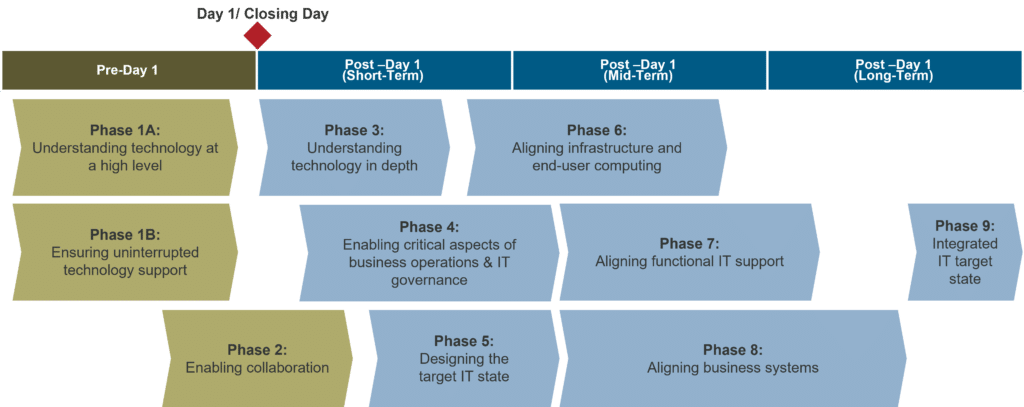
This visual roadmap exemplifies the strategic, phased approach to IT consolidation, breaking down the complex journey from pre-deal discovery to a final integrated target state into manageable workstreams to ensure a non-disruptive transition.
Element 2: The Operating Room: Disciplined Execution and Governance
With a clear blueprint, the focus shifts to execution. This is where surgical precision is required to avoid disrupting the day-to-day business. The key here is not speed, but control.
Ways to Manage Consolidation Without Disrupting Operations: The core principle is to de-risk the process through incremental, verifiable steps. A “big bang” cutover, where an old system is switched off and a new one is switched on overnight, is almost always a recipe for disaster. It introduces too many points of failure at once.
Instead, seasoned teams rely on a more prudent approach:
- Phased Rollouts: New systems are rolled out by business unit, geography, or function. This limits the “blast radius” if something goes wrong. A successful pilot with a smaller group builds confidence and provides invaluable lessons before a broader deployment.
- Parallel Runs: For mission-critical systems like payroll or core financials, the old and new systems are run in parallel for a set period. This allows teams to validate that the new system is producing identical, accurate results before the old one is decommissioned. It is expensive in the short term but cheap insurance against catastrophic failure.
- Robust Data Migration Strategy: Data is the most precious and perilous asset to move. A dedicated data migration workstream is essential. This process involves profiling and cleansing data in the source systems before migration, mapping it meticulously to the target system, performing multiple test migrations in a sandbox environment, and conducting a thorough validation after the final cutover. Skimping on data cleansing is a cardinal sin that leads to operational chaos downstream.
Common Mistakes That Cause Disruption: Beyond the “big bang” folly, several other common errors can derail a consolidation:
- Underestimating Complexity: Teams often fail to appreciate the web of undocumented customizations and integrations that have been built around a legacy system over years.
- Scope Creep: During the project, business units may see an opportunity to add new features and functionality to the target system. While tempting, this “while you’re in there” approach can endlessly delay the project and introduce new risks. Strong governance is needed to freeze the scope and defer enhancements until after the core consolidation is complete.
- Inadequate Testing: Rushing through user acceptance testing (UAT) to meet a deadline is a false economy. The time saved will be lost tenfold in post-go-live firefighting and emergency patching.
Tips and Tools for Effective Management: Modern tools can significantly de-risk the execution phase. Integration Platform as a Service (iPaaS) solutions can help manage the connections between cloud and on-premise systems during a transitional period. Specialized data migration software can automate parts of the extraction, transformation, and loading (ETL) process. Most importantly, a centralized project management office (PMO) armed with robust project management software is critical for tracking progress, managing dependencies, and providing a single source of truth for all stakeholders. This PMO acts as the air traffic control for the entire integration.
Element 3: The Human Element: Change Management and Continuous Communication
Ultimately, systems are used by people. The greatest source of operational disruption during an IT consolidation is not technical failure, but human resistance, confusion, and error. A technically perfect system that no one knows how or wants to use is a failure.
Effective change management is not an afterthought; it must be woven into the project from day one. This begins with identifying all stakeholder groups, from the executive team to the warehouse floor staff, and understanding how the consolidation will impact their daily work. A one-size-fits-all communication plan will fail. The CFO needs to know about financial reporting continuity, while a sales representative needs to know how their commission will be calculated in the new CRM.
The communication must be clear, consistent, and relentless. Employees are naturally anxious during a merger. Silence from leadership will be filled with rumors and fear. It is far better to communicate openly about the challenges and the timeline, even if the news is not all positive, than to leave people in the dark.
Furthermore, training cannot be a one-off webinar a week before go-live. A successful training program includes a mix of formats, from hands-on workshops to on-demand video tutorials. A “super-user” program, which identifies and trains influential employees within each department to act as first-line support for their peers, is an incredibly effective way to embed change and reduce the burden on the central IT helpdesk. The goal is to make employees feel supported and empowered, not like the change is being done to them.
Case Studies: The Three Pillars in Practice
Let’s examine how these pillars manifest in plausible, real-world scenarios.
Case 1: Global PharmaCo’s Phased Precision
When Global PharmaCo, a US-based pharmaceutical giant, acquired EuroBio, a European competitor with a strong R&D pipeline, the initial impulse from the board was to mandate a full-scale migration to Global PharmaCo’s single, global ERP system within 18 months. The CIO, an M&A veteran, successfully argued for a more nuanced strategic approach. Through a rapid assessment, his team demonstrated that the core value of the deal was in accelerating drug development and cross-selling patented drugs. The risk and disruption of force-fitting EuroBio’s highly regulated European manufacturing and finance operations into the US-centric ERP were immense and offered little short-term value.
Instead, they proposed a phased roadmap. Phase 1 focused on the highest-value integrations: merging the two companies’ R&D and clinical trial management systems to create a unified view of the product pipeline. They also integrated the CRM platforms to give sales teams visibility into the full, combined product portfolio. Phase 2, pushed out to year three, would tackle the longer, more complex task of harmonizing the ERPs, but only after a thorough analysis of the best long-term solution for the combined global entity. This strategic patience preserved operational stability in Europe, accelerated the realization of revenue synergies, and demonstrated a mature understanding that not everything needs to be consolidated immediately.
Case 2: FinTech Synergy’s Data-Driven Discipline
The merger of two mid-sized digital banks, creating FinTech Synergy, presented a formidable data migration challenge. The new entity needed to consolidate millions of customer accounts, transaction histories, and loan portfolios onto a single core banking platform to meet regulatory requirements and achieve operational efficiencies. Recognizing the catastrophic risk of data errors, the integration lead established a dedicated “Data Migration Command Center” with an almost fanatical devotion to process discipline.
They rejected a “lift and shift” approach. Instead, they invested eight weeks upfront in a data cleansing and profiling initiative, fixing thousands of data quality issues in the source systems before a single byte was moved. They conducted three full-scale mock migrations into a perfect replica of the production environment, each followed by a week of automated and manual data reconciliation. For the final cutover, they ran the old and new systems in parallel for 24 hours, processing live transactions on both to ensure 100% data parity. While this level of rigor added six weeks to the original timeline, the go-live was flawless. There were no major data-related operational disruptions, customer complaints were minimal, and regulatory auditors lauded their meticulous approach.
Case 3: Retail United’s People-First Rollout
When two national clothing retailers merged to form Retail United, one of the first major integration projects was the rollout of a new, unified Point-of-Sale (POS) and inventory management system across 1,200 stores. The project team knew that success depended entirely on the adoption and correct use of the system by tens of thousands of store associates. A technical failure would be bad, but widespread user error leading to incorrect inventory counts and chaotic checkout lines would be fatal.
Their change management plan was a masterclass in grassroots engagement. Six months before the first pilot, they created a “Store Champions” program, recruiting enthusiastic, tech-savvy associates from every district. These champions were brought to headquarters for intensive training, given early access to the system, and invited to provide direct feedback that led to several crucial user interface improvements. When the system was rolled out region by region, these local champions co-led the training sessions and served as the go-to experts for their colleagues. The central project team also maintained a constant communication loop through weekly newsletters, video updates from the CEO, and an “Ask Me Anything” forum. The result was a rollout that finished ahead of schedule with remarkably high user satisfaction and minimal disruption to store operations, proving that investing in your people is the best way to de-risk a technology project.
Conclusion
The work of IT system consolidation during a post-merger integration is undeniably one of the most complex and high-stakes endeavors in modern business. It is not an easy task, and its difficulty is compounded by today’s intricate and interconnected technology landscapes. However, it is not an insurmountable one.
Success does not come from a magic bullet or a single piece of software. It comes from a disciplined, methodical approach built on three pillars: a clear-eyed strategy that dares to question the necessity of consolidation, a surgically precise execution plan that prioritizes risk mitigation over raw speed, and an empathetic, relentless focus on the people who must navigate the change. By treating the process with the seriousness of a heart transplant—meticulously planning the procedure, executing with precision, and managing the patient’s recovery—M&A professionals can ensure the newly formed entity does not just survive the operation, but emerges stronger, healthier, and ready to thrive.
As you reflect on your own experiences, what non-negotiable principle or practice has proven most critical for your teams when navigating the complexities of post-merger IT integration?
 E2E Deal Insights
Leave a comment