

The Integration Trust Deficit: Communication Strategies That Determine Whether Your M&A Deal Delivers or Derails
Every M&A professional has witnessed it. The deal closes, the champagne flows, the press release lands, and within weeks a quiet erosion begins. Key talent updates their LinkedIn profiles. Customers start entertaining calls from competitors. Middle managers speak in carefully hedged language that means nothing and reassures no one. The culprit is rarely strategic misalignment or flawed financial modeling. The culprit is almost always communication — or more precisely, the absence of it when it matters most.
The stakes are well established. Research consistently estimates that between 70 and 90 percent of mergers and acquisitions fail to deliver their projected value, and a significant proportion of that failure traces back to post-merger integration breakdowns rooted in trust collapse. Trust, of course, is not a warm abstraction. Trust is the operational lubricant that determines whether employees exercise discretionary effort, whether customers maintain purchasing patterns, and whether key stakeholders remain patient through the inevitable turbulence of integration. Communication is how trust is built, maintained, repaired, and — when handled poorly — destroyed.
This article examines why communication during integration deserves the same rigor, planning, and executive attention as synergy capture or systems migration. It explores three core communication strategies that sustain trust across the complex stakeholder landscape of a deal, and it illustrates each strategy through real cases where companies navigated this challenge with measurable success. The goal is not to offer platitudes about “transparency” but to provide a practical, globally applicable framework that seasoned deal professionals can deploy in their next integration.
Core Themes, Current Trends, and Definitions Worth Getting Right
Why Communication Becomes the Integration Bottleneck
Integration is fundamentally a change management exercise conducted under conditions of acute uncertainty. Every stakeholder — from the acquiring company’s board to the most junior employee of the target — operates with incomplete information about their future. Human beings respond to uncertainty in predictable ways: they fill information vacuums with worst-case assumptions, they default to self-protective behavior, and they assign intent to silence. A company that says nothing during integration is not communicating neutrality. It is communicating indifference, or worse, that bad news is being withheld.
Good and thoughtful communication matters during integration because the transaction has disrupted the implicit contract between an organization and its people. Employees accepted their roles under a certain set of expectations about culture, leadership, career trajectory, and stability. An acquisition rewrites all of those expectations simultaneously. Communication is the mechanism through which the new implicit contract is negotiated and accepted — or rejected.
What Are Communication Strategies in an M&A Context?
A communication strategy in integration is not a messaging calendar, though it includes one. It is a deliberate, structured plan that defines who needs to know what, when they need to know it, through which channels, from which voices, and with what degree of candor. It accounts for the asymmetry of information that naturally exists between deal insiders and broader stakeholders, and it manages that asymmetry intentionally rather than accidentally.
Effective integration communication strategies share several characteristics. They are audience-segmented, recognizing that shareholders require different information, framing, and cadence than frontline employees. They are multi-directional, creating channels for feedback and questions rather than relying on one-way broadcasts. They are temporally aware, mapping communication intensity to the integration timeline and escalating transparency as decisions crystallize. Most importantly, they are honest about what is unknown, because credibility in integration depends far more on acknowledging uncertainty than on projecting false confidence.
The Current Landscape
Several trends shape how integration communication operates today. First, the speed of information flow has made controlled messaging far more difficult. Employees share details on internal chat platforms, social media, and anonymous forums like Glassdoor and Blind within hours of any announcement. A communication strategy that assumes the company controls the narrative is already outdated before it launches.
Second, cross-border deals add layers of complexity. Cultural norms around directness, hierarchy, and the role of labor representation vary dramatically across jurisdictions. A communication approach calibrated for a U.S. workforce may land poorly with employees in Germany, Japan, or Brazil, where expectations about consultation, formality, and the role of works councils differ materially.
Third, the rise of remote and hybrid workforces has eliminated the hallway conversation as an informal trust-building mechanism. Leaders can no longer rely on physical presence and body language to convey reassurance. Every message must be more intentional because fewer ambient signals exist to supplement it.
Fourth, stakeholder expectations around purpose and values have intensified. Employees and customers increasingly evaluate transactions not just on financial logic but on cultural compatibility and ethical alignment. Communication strategies must address the “why” of a deal at a level that goes beyond shareholder value creation, particularly when the deal involves workforce restructuring or market consolidation.
Key Stakeholders and Their Communication Needs
Understanding the stakeholder map is foundational. Each group occupies a different position in the information hierarchy and carries different anxieties:
- Shareholders and owners need confidence that integration will deliver the value thesis. They care about synergy timelines, capital allocation, and risk management. Their trust erodes when milestones slip without explanation.
- Employees of the acquiring company often feel overlooked because the integration spotlight shines on the target. They worry about cultural dilution, resource diversion, and whether leadership attention will be consumed by the acquisition at the expense of their own priorities.
- Employees of the acquired company face the most acute uncertainty. They wonder whether their roles will survive, whether their culture will be respected, and whether new leadership will value their contributions. Their trust is the most fragile and the most consequential to protect.
- Financial advisors, legal advisors, and consultants supporting the integration need clarity on decision rights, timelines, and access. Misalignment among advisors creates conflicting messages that reach the broader organization in distorted form.
- Customers and suppliers require assurance that service continuity will be maintained and that contractual commitments will be honored. Their trust directly affects revenue retention during the integration period.
Each audience requires a tailored approach, but all audiences share one common requirement: they need to feel that the people making decisions are being straight with them.
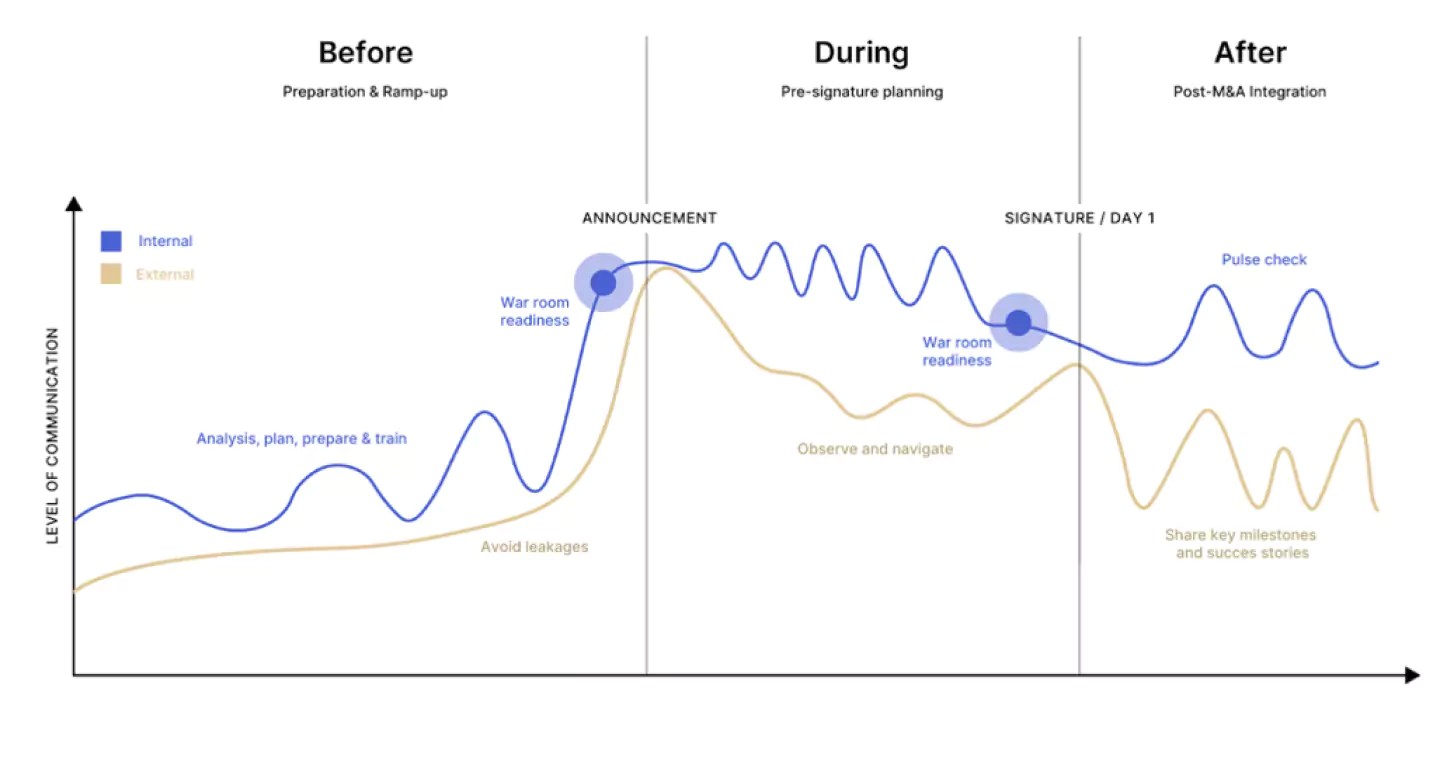
M&A communication intensity across the deal lifecycle: This diagram maps how internal and external communication levels evolve from preparation through post-merger integration, highlighting the critical spikes at announcement and Day 1 where war room readiness, structured transparency, and pulse checks sustain stakeholder trust.
Three Communication Strategies That Build and Maintain Trust During Integration
Strategy One: Structured Transparency — Saying What You Know, What You Don’t, and When You Will
The single most corrosive force in integration communication is the gap between what leadership knows and what stakeholders are told. Structured transparency is the discipline of closing that gap as rapidly as decisions allow, while being explicitly honest about the areas where decisions have not yet been made.
This strategy matters because trust is a function of predictability. When stakeholders can predict that leadership will share information as it becomes available — even when that information is incomplete — they develop confidence in the process. When leadership goes silent or offers vague reassurances that are later contradicted by events, trust fractures in ways that are extremely difficult to repair.
Structured transparency operates on three principles. First, communicate early and often, even when the message is “we don’t have an answer yet.” A scheduled cadence of updates — weekly town halls, integration bulletins, leadership Q&A sessions — creates a rhythm that stakeholders can rely on. Second, differentiate clearly between decisions that have been made, decisions that are in progress, and decisions that have not yet been addressed. This three-category framework prevents stakeholders from interpreting “no news” as “bad news being hidden.” Third, close every communication loop. If leadership says “we will update you on office consolidation by the end of Q2,” that update must arrive on time, even if the update is that the decision has been delayed. Missed commitments on communication timing do more damage than the underlying uncertainty itself.
Implementing structured transparency requires courage from leadership. It means standing in front of an audience and admitting that the integration plan is still being developed in certain areas. It means resisting the temptation to offer premature reassurance. It means accepting that some stakeholders will react negatively to uncertainty, and understanding that their reaction to concealed uncertainty would be far worse.
Strategy Two: Audience-Segmented Messaging With a Unified Core Narrative
One of the most common integration communication failures is treating all stakeholders as a single audience. The CEO’s message to shareholders about accretive synergies and EBITDA enhancement does not address the acquired company’s engineering team wondering whether their office will close. Sending the same email to both groups serves neither.
Audience-segmented messaging recognizes that different stakeholders need different levels of detail, different emotional registers, and different channels. However, segmentation without narrative coherence creates a different problem: stakeholders compare notes, discover inconsistencies, and conclude that someone is being misled.
The solution is to build communication around a unified core narrative — a clear, concise explanation of why the deal was done, what the combined entity aspires to become, and what principles will guide integration decisions. This core narrative serves as the foundation from which all audience-specific messages are developed. The message to employees emphasizes how the narrative affects their roles and growth. The message to customers emphasizes continuity and enhanced capability. The message to shareholders emphasizes value creation mechanics. The underlying story remains consistent.
Designing audience-segmented messaging requires mapping each stakeholder group’s primary concerns and information needs. For employees of the acquired company, the priority concerns typically follow a predictable hierarchy: job security, reporting structure, compensation and benefits, cultural integration, and career development. Communication should address these concerns in that order, because people cannot absorb information about long-term career paths when they are uncertain whether they will have a job next month.
Channel selection also matters enormously. Senior leadership should deliver the most consequential messages — organizational changes, role eliminations, cultural commitments — directly and in formats that allow for questions. Routine updates can flow through written channels. Critically, direct managers should be equipped and empowered to translate enterprise-level messages into team-level meaning. Research on organizational communication consistently shows that employees trust their direct manager more than any other source. An integration communication strategy that bypasses middle management forfeits its most credible channel.
Strategy Three: Bidirectional Communication Architecture — Listening as Strategy, Not Courtesy
Most integration communication plans are fundamentally broadcast architectures. Leadership decides what to say, crafts the message, and pushes it outward. Feedback mechanisms, if they exist at all, are afterthoughts — suggestion boxes, anonymous surveys conducted months into the integration, or town hall Q&A sessions where only the bravest souls raise their hands.
Bidirectional communication treats listening as a strategic function, not a gesture of inclusiveness. It creates formal and informal mechanisms for stakeholders to surface concerns, ask questions, share observations, and flag emerging problems. This strategy maintains trust because it signals that leadership values stakeholder perspectives and is willing to adapt based on what it hears.
The practical architecture of bidirectional communication includes several elements. Pulse surveys deployed at regular intervals during integration capture sentiment trends before they become crises. Integration ambassadors or champions — respected individuals within both organizations who serve as informal conduits between the workforce and leadership — provide qualitative intelligence that surveys miss. Dedicated Q&A platforms, whether digital or in-person, allow stakeholders to ask questions and receive answers that are visible to the broader audience, reducing the repetition of the same anxieties across different groups. Skip-level meetings, where senior leaders meet with employees two or more levels below them, provide unfiltered perspectives that are often softened or lost in hierarchical reporting.
Bidirectional communication also requires something that many integration leaders find uncomfortable: acting on what they hear. If employees consistently raise a concern and leadership consistently ignores it, the listening mechanism becomes a trust liability rather than an asset. Stakeholders must see evidence that their input influences decisions, even if the influence is partial or the decision does not go the way they hoped. Explaining why a concern was heard but not acted upon is infinitely more trust-preserving than pretending the concern was never raised.
Three Real-World Cases: Communication Strategies in Practice
Case One: Microsoft’s Acquisition of LinkedIn — Structured Transparency at Scale
When Microsoft acquired LinkedIn in 2016 for $26.2 billion, the deal combined two companies with very different cultures, operating models, and employee expectations. Microsoft CEO Satya Nadella and LinkedIn CEO Jeff Weiner executed a communication strategy that exemplified structured transparency.
Within hours of the deal announcement, both leaders published open letters to their respective workforces. Nadella’s letter to Microsoft employees explained the strategic rationale in clear, non-jargon language and explicitly stated that LinkedIn would retain its distinct brand, culture, and independence. Weiner’s letter to LinkedIn employees addressed their specific concerns: he confirmed that he would remain CEO, that LinkedIn’s San Francisco headquarters would remain operational, and that the company’s mission would not change.
Crucially, both leaders acknowledged the areas where decisions had not yet been made and committed to providing updates as integration planning progressed. They maintained a regular cadence of communication throughout the integration period, including joint appearances and internal Q&A sessions. The structural decision to preserve LinkedIn’s operational independence was itself a communication act — it signaled to LinkedIn employees that their identity and contributions were valued, not merely absorbed.
The result was remarkably low attrition among LinkedIn’s key talent during integration, and LinkedIn’s revenue growth actually accelerated in the years following the acquisition. The communication strategy did not operate in isolation — the integration model itself was well designed — but the transparency and speed of communication established a trust foundation that made everything else possible.
Case Two: Danaher’s Serial Acquisition Model — Audience-Segmented Messaging Through the Danaher Business System
Danaher Corporation has completed hundreds of acquisitions over its history, and its integration playbook is among the most refined in global M&A. A key element of that playbook is rigorously audience-segmented communication built around the Danaher Business System (DBS), which serves as the company’s unified core narrative.
When Danaher acquires a company, communication to the acquired workforce centers on DBS as both a philosophy and a practical toolkit. Employees learn that they are joining a system designed to drive continuous improvement, and the messaging is calibrated to their functional context. Manufacturing employees receive communication about lean process improvement. Sales teams learn about Danaher’s approach to growth tools. R&D staff hear about innovation acceleration.
Simultaneously, Danaher’s communication to its own shareholders frames each acquisition within the broader portfolio strategy, emphasizing value creation mechanics and margin expansion trajectories. Customer-facing communication emphasizes continuity and the enhanced resources that Danaher’s platform provides.
The unified core narrative — DBS as the engine of value creation — remains consistent across all audiences. The specifics change based on audience needs. This approach works because it gives every stakeholder a coherent answer to the question “what does this acquisition mean for me?” while ensuring that no stakeholder group encounters a message that contradicts what another group has been told. Danaher’s track record of successful integrations across diverse industries and geographies demonstrates the scalability of this approach.
Case Three: Unilever’s Acquisition of Dollar Shave Club — Bidirectional Communication Preserving Entrepreneurial Culture
When Unilever acquired Dollar Shave Club in 2016 for approximately $1 billion, the deal presented a classic integration communication challenge: how does a 400-person direct-to-consumer startup maintain its identity and energy inside a 170,000-person multinational consumer goods conglomerate?
Unilever’s approach emphasized bidirectional communication from the outset. Rather than imposing Unilever’s integration processes wholesale, leadership created cross-functional working groups that included Dollar Shave Club employees at every level. These groups served as formal feedback mechanisms, ensuring that integration decisions accounted for the startup’s perspective on what made its culture and business model distinctive.
Dollar Shave Club founder Michael Dubin remained in place as CEO and served as the primary communication voice to his team, preserving the trust relationship that employees had with their existing leadership. Unilever’s leadership communicated directly with Dollar Shave Club employees during key moments but respected the established hierarchy and cultural norms of the acquired company.
The bidirectional architecture extended to customers. Dollar Shave Club’s subscriber base was highly engaged and brand-loyal, and any perception that a corporate parent was diluting the brand’s personality would have driven churn. Unilever and Dollar Shave Club jointly monitored customer sentiment through social media and subscription data, using that feedback to calibrate how (and whether) to communicate the Unilever connection to the consumer base.
This case illustrates that bidirectional communication is not merely about employee engagement. It is about creating information flows that protect the sources of value that motivated the acquisition in the first place. When an acquirer buys a company for its culture, talent, and customer relationships, the communication strategy must protect those assets with the same diligence applied to protecting intellectual property or revenue contracts.
Designing Your Communication Strategy: Principles That Stick
For practitioners building integration communication plans, several principles are worth internalizing because they are easy to remember and difficult to execute without deliberate effort:
- Speed beats perfection. A timely message that is 80 percent complete earns more trust than a polished message delivered three weeks late. Stakeholders penalize silence more than imprecision.
- The messenger matters as much as the message. The same information delivered by a trusted direct manager and by an unknown corporate communications officer will generate fundamentally different levels of belief and engagement.
- Acknowledge the emotional reality. Integration is stressful, disorienting, and sometimes painful. Communication that ignores the human dimension in favor of pure strategic narrative feels tone-deaf to the people living through the experience.
- Communicate decisions and the reasoning behind them. Stakeholders accept difficult outcomes far more readily when they understand the logic that produced them. Unexplained decisions breed conspiracy theories.
- Repetition is not redundancy. Neuroscience and communication research confirm that messages must be received multiple times through multiple channels before they are internalized. Saying something once in a town hall and assuming it has been absorbed is a planning failure.
- Monitor and adapt. Track sentiment, measure message reach, solicit feedback, and adjust the plan in real time. A communication strategy that cannot flex in response to emerging realities is a document, not a strategy.
These principles apply across geographies, though their execution must account for local norms. In jurisdictions with works council requirements, structured transparency includes formal consultation processes mandated by law. In cultures with high power distance, bidirectional communication may require more structured and anonymous channels to encourage candor. In markets where employee mobility is high, communication urgency around retention increases because competitors will actively recruit during integration uncertainty.
Conclusion
Communication during integration is not a supporting function. It is a core driver of whether an acquisition creates or destroys value. The trust that enables successful integration — trust between leadership teams, between organizations, between companies and their customers — is built and maintained through deliberate, structured, audience-aware, and bidirectional communication. Structured transparency reduces the corrosive effects of uncertainty. Audience-segmented messaging ensures that every stakeholder receives the information they need in the form they can absorb. Bidirectional communication architecture transforms stakeholders from passive recipients into active participants whose intelligence improves the integration itself.
The companies that excel at integration communication share a common trait: they treat communication as a strategic workstream that receives dedicated resources, executive sponsorship, and continuous measurement. They plan it before the deal closes, they execute it with discipline, and they adapt it as reality unfolds.
The financial models, the synergy targets, and the integration project plans all matter enormously. But none of them can succeed if the people responsible for execution have lost trust in the people leading the process.
So, for your next integration: are you investing as much rigor in your communication strategy as you are in your synergy model, and if not, what is the real cost of that gap?
 E2E Deal Insights
Leave a comment