

Operating-Model Redesign After a Merger: How Leading Companies Define Structure, Decision Rights, Process Ownership, and Performance Management
Every merger begins with a strategic ambition. One company seeks scale, another seeks market access, and a third wants capabilities that would take years to build organically. Boards approve transactions based on compelling synergy models, expanded customer reach, stronger technology portfolios, or geographic growth opportunities. Yet seasoned M&A professionals understand that the transaction itself rarely determines long-term success. The defining factor is whether the combined organization can actually operate effectively once integration begins.
This challenge explains why operating-model redesign has become one of the most critical dimensions of post-merger integration. A merger may combine ownership structures overnight, but it does not automatically create operational alignment. The newly formed enterprise must determine how decisions will be made, who owns key processes, how accountability will function across regions and business units, and how performance will be measured consistently throughout the organization. Without clarity in those areas, even strategically logical mergers can lose momentum quickly.
The complexity increases further in global transactions. Cross-border mergers often involve different regulatory environments, management cultures, reporting philosophies, and operational standards. One organization may prioritize centralized governance and strict process control, while the other succeeds through local autonomy and decentralized decision-making. If leadership fails to reconcile these differences early, the combined company can spend years trapped between competing operating philosophies.
Operating-model redesign therefore deserves treatment as a core value-creation initiative rather than a secondary organizational exercise. Cost synergies, procurement efficiencies, digital integration, customer retention, and commercial coordination all depend on operational clarity. Companies do not capture merger value through organizational charts alone. They capture value when people across the enterprise understand how the organization works, who owns decisions, and which priorities matter most.
The strongest acquirers recognize another important reality. The objective is not to design the most elaborate governance structure or the most sophisticated matrix model. The objective is to create an operating environment that supports execution, accountability, scalability, and adaptability simultaneously. That balance often separates integrations that create durable enterprise value from those that become prolonged exercises in organizational negotiation.
Understanding the Core Themes Behind Operating-Model Redesign
What Is an Operating Model?
An operating model defines how an organization translates strategy into execution. It establishes the practical mechanisms through which the business functions on a daily basis. While strategy determines where the company intends to compete, the operating model determines how people, processes, governance, technology, and performance systems interact to deliver results.
In practical terms, the operating model shapes nearly every operational activity inside the enterprise. It defines reporting relationships, approval structures, governance forums, accountability mechanisms, technology ownership, budgeting authority, customer interaction models, and performance expectations. It also influences organizational behavior because employees naturally adapt to the incentives and governance structures leadership establishes.
A well-designed operating model creates clarity and consistency across the organization. Employees understand who owns decisions, how work flows between functions, and how success gets measured. A poorly designed model produces the opposite outcome. Decision-making slows, accountability becomes fragmented, functions duplicate work, and customers experience inconsistent execution. Organizations often attempt to solve these problems by adding additional oversight layers, although excessive governance frequently amplifies complexity instead of reducing it.
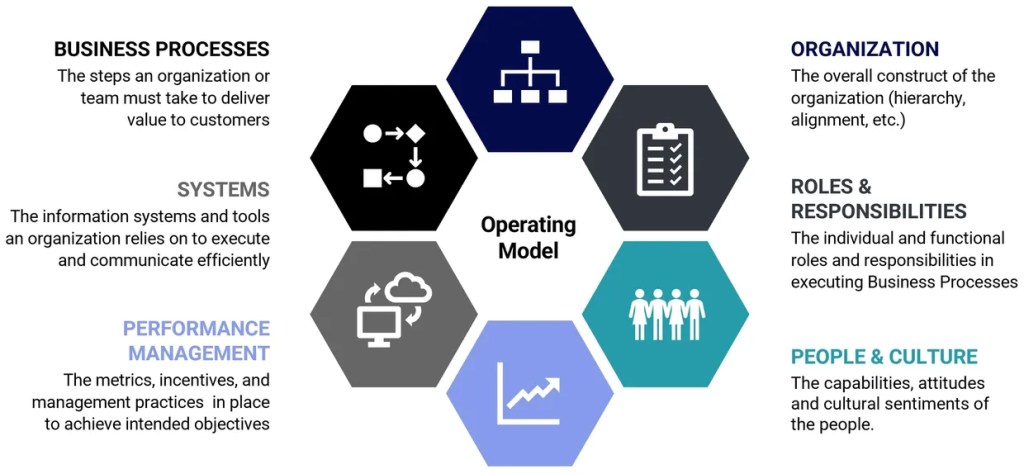
An overview of the core operating-model levers that organizations redesign after a merger, including structure, governance, decision rights, process ownership, technology, talent, and performance management, to align the combined enterprise for scalable execution and long-term value creation.
What Is Operating-Model Redesign?
Operating-model redesign refers to the deliberate restructuring of how an organization operates following a merger, acquisition, carve-out, or major transformation initiative. The redesign process extends far beyond organizational restructuring. It involves rethinking governance, process ownership, decision authority, performance management, technology integration, and accountability structures across the combined enterprise.
After a merger, redesign becomes necessary because the two organizations rarely operate in compatible ways. One company may organize around products while the other prioritizes geographic regions. One business may use centralized procurement and standardized systems while the other allows extensive local flexibility. Leadership teams may also differ significantly in management style, risk tolerance, and escalation expectations.
Without deliberate redesign, the merged organization often inherits operational inconsistencies that slow execution and weaken integration outcomes. Employees become uncertain about priorities and authority. Customers receive mixed experiences. Functions operate according to conflicting standards. Informal workarounds gradually replace formal governance mechanisms.
An effective redesign effort addresses these tensions directly by establishing a coherent future-state model. That does not mean every activity must become globally standardized. In many cases, selective variation remains commercially necessary. The real objective is operational coherence rather than operational uniformity.
Why Is Operating-Model Redesign Often Necessary After a Merger?
Most mergers create immediate operational overlap. Leadership structures duplicate one another, systems conflict, and responsibilities blur across functions and business units. In the early integration period, employees frequently spend significant time trying to determine who now owns decisions, which processes apply, and how competing priorities should be resolved.
Operating-model redesign addresses this uncertainty by creating a clear framework for how the combined organization will function. It aligns governance with the strategic rationale of the deal and reduces operational friction that would otherwise delay integration progress.
The need for redesign becomes especially pronounced when merger value depends on coordinated execution. Procurement synergies require consolidated authority. Shared services require standardized workflows. Cross-selling depends on aligned customer ownership models. Technology integration requires governance over systems, data, and investment priorities. These outcomes cannot emerge through informal coordination alone.
At the same time, redesign efforts must avoid creating unnecessary bureaucracy. Some organizations become so focused on governance precision that they unintentionally build operating environments where decision-making slows dramatically. The strongest redesigns simplify complexity and clarify accountability without overwhelming the organization with procedural overhead.
Is Operating-Model Redesign Always Necessary?
Not every merger requires a comprehensive redesign. Some acquisitions intentionally preserve operational independence because the acquired business derives competitive advantage from agility, entrepreneurial culture, or specialized market positioning. Certain private equity ownership models also favor decentralized governance structures when operational integration offers limited value.
However, redesign becomes increasingly important when the transaction depends on integration synergies, platform consolidation, or enterprise-wide coordination. Mergers involving overlapping customers, global supply chains, digital transformation initiatives, or shared operating infrastructure almost always require meaningful operating-model changes.
The extent of redesign should therefore reflect the strategic logic behind the transaction. A fully integrated merger requires different governance structures than a portfolio acquisition designed primarily for financial ownership. Problems often arise when organizations apply standardized integration templates without considering the specific objectives of the deal.
When Should Redesign Planning Begin?
The most effective acquirers begin operating-model planning during due diligence rather than after close. Early preparation allows leadership teams to identify governance conflicts, leadership overlaps, process inconsistencies, and integration dependencies before operational complexity intensifies.
This early planning stage does not require every detail to be finalized immediately. However, it does require leadership alignment around key principles. Organizations should determine which decisions require Day 1 clarity, which capabilities need immediate integration, and which areas can transition gradually over time.
Certain governance decisions cannot remain ambiguous after close. Financial authority, customer ownership, regulatory accountability, executive decision rights, and operational escalation structures typically require immediate definition because uncertainty in those areas can disrupt execution rapidly. Organizations that delay these decisions often spend months operating in temporary structures that create confusion and weaken accountability.
The Most Critical Components of Operating-Model Redesign
Enterprise Structure and Organizational Design
The organizational structure establishes the foundation of the operating model because it determines how accountability flows across the combined enterprise. Leaders must decide whether the organization will primarily organize around geographies, products, customer segments, functions, channels, or business lines. These choices shape collaboration patterns, reporting complexity, and operational responsiveness for years after the merger closes.
Many integration programs default automatically to the acquiring company’s legacy structure. While this approach may appear efficient initially, it often preserves assumptions that no longer support the strategic direction of the combined organization. A merger creates a rare opportunity to redesign around future priorities rather than historical precedent, and companies that fail to use that opportunity frequently carry structural inefficiencies forward into the next phase of growth.
Several structural questions typically deserve early attention:
- Which activities should remain centralized globally?
- Which business units require local autonomy?
- Where should P&L accountability reside?
- How should global functions interact with regional leadership?
- Which capabilities should operate through shared services?
- Which customer-facing activities require embedded business ownership?
The strongest organizational structures balance consistency with flexibility. Excessive centralization may improve control and efficiency, but it can also reduce responsiveness in local markets. Excessive decentralization often protects agility while creating duplication and fragmented governance. Effective operating models establish enough standardization to create scale advantages without weakening customer responsiveness or operational speed.
Structural clarity also reduces organizational fatigue. In heavily matrixed environments, employees can spend substantial time navigating approval paths and stakeholder expectations instead of executing priorities. Eventually, coordination meetings begin to substitute for actual decision-making, which rarely improves operational efficiency no matter how sophisticated the meeting agenda appears.
Decision Rights and Governance
Decision rights define how authority operates within the merged organization. This area frequently becomes one of the most politically sensitive dimensions of integration because governance changes directly affect leadership influence, resource control, and operational accountability.
A well-designed governance framework establishes clarity around who can decide, approve, recommend, execute, or escalate specific activities. Without this clarity, organizations often develop overlapping approval structures where multiple stakeholders believe they own the same decision. In other cases, no leader possesses sufficient authority to move decisions forward efficiently.
Critical governance domains typically include:
- Capital allocation and investment approval.
- Pricing authority and commercial exceptions.
- Technology standards and architecture decisions.
- Procurement thresholds and supplier governance.
- Product development prioritization.
- Talent and hiring authority.
- Risk management and regulatory escalation.
- Integration prioritization and transformation funding.
Strong governance frameworks reduce operational friction because employees understand how decisions progress through the organization. They also improve execution speed by eliminating unnecessary escalation layers.
Governance structures should evolve over time as integration maturity increases. During the early stages of integration, organizations often require more centralized oversight to manage risk and coordinate priorities. As the business stabilizes, authority can gradually shift closer to operational teams where responsiveness and customer proximity become more valuable.
Process Ownership and Operational Accountability
One of the most common causes of post-merger inefficiency involves fragmented process ownership. Critical enterprise processes often span multiple functions, systems, and regions, yet no single leader possesses authority over the full workflow. As a result, optimization efforts occur in isolated silos rather than across the end-to-end process.
Effective operating models establish explicit ownership for major enterprise processes such as:
- Order-to-cash.
- Procure-to-pay.
- Record-to-report.
- Customer onboarding.
- Product development.
- Supply-chain planning.
- Incident management.
- Regulatory reporting.
- Workforce management.
Process owners should possess authority to define standards, coordinate improvements, establish controls, monitor KPIs, and align technology requirements across functions. Their accountability extends beyond process documentation. They become responsible for ensuring that operational performance improves consistently across the organization.
This distinction matters because functional management alone rarely guarantees operational coordination. A finance leader may oversee accounting teams, while operations manages fulfillment and procurement controls supplier relationships. Without integrated process ownership, each function may optimize its own objectives while unintentionally weakening broader enterprise performance.
Global organizations face additional complexity because regional regulatory requirements and market conditions often require selective process variation. The strongest operating models distinguish carefully between activities that require strict global consistency and activities where localized flexibility remains operationally appropriate.
Performance Management and KPI Alignment
Performance management systems shape organizational behavior more directly than many integration teams initially realize. Employees naturally prioritize the metrics, incentives, and objectives that leadership measures consistently. If the merged organization inherits conflicting performance frameworks, operational alignment becomes extremely difficult regardless of how carefully the structure has been redesigned.
An effective performance-management framework aligns enterprise priorities with operational execution through a coordinated KPI architecture. Organizations should define:
- Enterprise-wide financial objectives.
- Functional performance metrics.
- Operational efficiency indicators.
- Customer experience measures.
- Synergy realization targets.
- Transformation milestones.
- Talent and retention indicators.
- Risk and compliance metrics.
The most effective KPI systems create vertical alignment across the organization. Enterprise goals should cascade logically into regional, functional, and operational objectives so that teams reinforce shared priorities rather than competing against one another.
Integration leaders must also determine which metrics should remain globally standardized and which should allow regional flexibility. This balance becomes particularly important in multinational organizations where local market realities vary significantly across geographies.
Balanced performance management also protects organizations from excessive short-termism. Some integrations become overly focused on immediate cost extraction at the expense of customer retention, innovation capacity, employee engagement, or operational resilience. While synergy delivery remains important, sustainable integration success usually depends on maintaining long-term organizational health alongside financial discipline.
Technology, Data, and Digital Governance
Technology integration increasingly defines whether operating-model redesign succeeds or struggles. Modern enterprises depend heavily on interconnected systems, data platforms, analytics environments, and digital workflows. When merged organizations fail to align technology governance effectively, operational fragmentation often persists even after structural integration appears complete.
The combined organization must determine several critical issues early in the integration process:
- Which systems become enterprise standards?
- Which legacy platforms will retire?
- Who owns master data governance?
- How will technology investments be prioritized?
- Which cybersecurity standards apply globally?
- How will AI governance and digital controls operate?
- Which reporting systems become authoritative?
Technology governance affects far more than infrastructure efficiency. It directly influences process consistency, reporting accuracy, customer experience, and management visibility across the organization.
Data governance deserves particularly careful attention because merged organizations often discover conflicting definitions for customers, products, profitability metrics, and operational indicators. Leadership teams cannot make reliable decisions when core data definitions differ across business units or regions. In some integrations, executives spend substantial time reconciling reports rather than discussing business performance itself.
Strong digital governance also supports scalability. Organizations that align systems and data standards effectively create stronger foundations for future acquisitions, automation initiatives, and AI-enabled decision-making capabilities.
Talent, Leadership, and Cultural Integration
Operating models ultimately succeed through human behavior rather than structural design alone. Leadership alignment, employee adoption, and cultural integration therefore become essential components of successful redesign efforts.
The combined organization must define leadership accountabilities clearly and communicate how executives are expected to collaborate across the enterprise. Employees watch leadership behavior closely during integration periods, particularly when uncertainty remains high. Mixed signals from senior leaders can weaken confidence rapidly and encourage siloed decision-making.
Several talent-related priorities typically require explicit definition:
- Critical-role ownership and succession planning.
- Workforce planning accountability.
- Leadership governance structures.
- Talent mobility and promotion principles.
- Capability-development priorities.
- Retention strategies for key personnel.
- Cultural integration expectations.
Cultural integration deserves practical treatment rather than symbolic messaging alone. Culture becomes visible through operational behavior, including decision-making speed, escalation practices, collaboration norms, risk tolerance, and incentive structures. Organizations that claim to value collaboration while rewarding only individual business-unit performance often create predictable internal tension.
The strongest integrations reinforce cultural expectations through governance mechanisms, performance systems, and leadership behavior rather than relying exclusively on communication campaigns. Employees ultimately trust what the organization rewards operationally more than what it describes aspirationally.
Conclusion
Operating-model redesign remains one of the defining factors in post-merger success because it determines how the combined organization functions once transaction excitement fades and operational reality takes over. While strategic logic may justify the merger initially, long-term value creation depends on whether the organization can execute consistently across governance, processes, technology, talent, and performance management.
Successful redesign requires more than structural consolidation. It requires disciplined alignment across decision rights, accountability frameworks, process ownership, KPI systems, digital governance, and leadership behavior. Organizations that address these dimensions thoughtfully create clearer operating environments, stronger execution discipline, and more sustainable integration outcomes.
Experienced M&A leaders understand that ambiguity creates measurable operational cost. Unclear authority slows decisions, fragmented ownership weakens accountability, and conflicting incentives undermine collaboration. Over time, these issues erode customer confidence, delay synergy realization, and reduce organizational effectiveness. Conversely, companies that establish clear operating principles early create stronger foundations for scalability, resilience, and long-term growth.
As mergers become increasingly global, technology-enabled, and operationally interconnected, operating-model redesign will continue to grow in strategic importance. The organizations that excel at integration will not necessarily be the ones with the most aggressive synergy targets or the most elaborate governance structures. They will be the organizations capable of designing operating models that balance clarity, accountability, flexibility, and execution speed across increasingly complex enterprises.
The question many integration leaders continue to face is therefore not whether operating-model redesign matters. The more important question is whether leadership teams are willing to make the difficult governance and accountability decisions early enough to prevent operational ambiguity from becoming embedded in the organization for years after the merger closes.


Leave a comment