

Decoding the Human Architecture: A Practitioner’s Guide to Cultural Distance and Leadership Alignment in M&A
Financial models quantify corporate synergies with absolute precision, but human behavior frequently disrupts those calculations. Seasoned mergers and acquisitions professionals recognize that cultural friction destroys transactional value faster than market volatility. Corporate history contains numerous examples of strategically sound deals that suffered catastrophic value leakage during post-merger integration. This article addresses the empirical reality that operational integration succeeds only when leadership intentionally manages the human operating system.
Organizations cannot manage what they do not measure, and this principle applies directly to corporate culture. Relying on vague intuition or superficial surveys during a multi-billion-dollar transaction introduces unacceptable operational risk. Deal architects require rigorous frameworks to analyze the behavioral realities of both the acquirer and the target asset. This article provides a comprehensive blueprint for identifying, measuring, and bridging corporate cultural divides to ensure workforce adoption.
Core Themes, Current Trends, and Key Concepts
Defining Cultural Integration Diagnostics
A cultural integration diagnostic represents a rigorous, data-driven assessment of the operational norms, behavioral patterns, and underlying belief structures of merging organizations. This diagnostic mechanism moves beyond superficial value statements to isolate the actual mechanics of how work occurs within an enterprise. Practitioners design these assessments to map operational realities before the formal day-one integration milestone. The process uncovers structural misalignments that can impede post-merger collaboration and decision-making efficiency.
The Value Proposition in Post-Merger Integration
Deploying diagnostics early in the transaction lifecycle protects the core deal thesis from operational stagnation. Quantitative studies demonstrate that cultural misalignment accounts for nearly thirty percent of failed financial targets in corporate mergers. Early diagnostics reveal hidden organizational friction points that would otherwise stall critical timeline dependencies. This proactive approach allows integration management offices to design targeted interventions before employee resistance hardens. By identifying integration risks early, deal teams can safeguard business continuity and protect customer-facing operations.
Understanding and Quantifying Cultural Distance
Cultural distance defines the structural divergence between the organizational behaviors, communication norms, and governance models of two distinct corporate entities. Historically, practitioners relied exclusively on national macroeconomic frameworks to estimate these variances in cross-border transactions. Modern M&A advisory utilizing advanced analytics evaluates cultural distance at the micro-foundational level of specific corporate operating models. Corporate dealmakers utilize several advanced methodological tools to quantify this distance effectively:
- Organizational Network Analysis: This approach maps digital collaboration footprints to identify how information naturally flows across corporate boundaries.
- Natural Language Processing: Advanced algorithms analyze anonymized public employee reviews to isolate disparate sentiment trends.
- Psychometric Leadership Profiling: Behavioral assessments quantify how executive teams make choices and respond to environmental stressors.
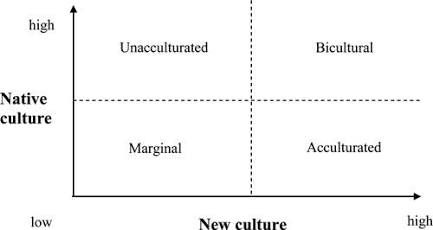
Source: ResearchGate
When analyzing cultural distance, integration leaders must evaluate how employees will respond to the newly dominant corporate operating model. The matrix model of acculturation shown above illustrates the distinct behavioral quadrants that emerge when individuals navigate two corporate realities. If an acquired workforce retains high affinity for their native culture while rejecting the new culture, they remain unaccultured and highly resistant. The ideal state for a blended enterprise is the bicultural quadrant, where employees successfully preserve core legacy capabilities while adopting the strategic operating mechanisms of the acquirer.
Driving Workforce Adoption and Interventions
Workforce adoption requires a systematic migration from legacy working habits to the newly defined target operating model. Alignment does not happen through corporate town halls or inspirational executive emails alone. Instead, change agents must anchor culture work in specific behavioral mechanisms and operational forums where employees interact daily. Executives must intentionally design structural interventions that address both leadership team dynamics and cross-company collaboration points. This tactical approach converts abstract cultural values into observable, repeatable management practices.
Critical Cultural Dimensions for M&A Diagnostics
Practitioners must utilize a standardized matrix of structural parameters to evaluate cultural distance accurately. These dimensions establish the baseline data required to construct leadership alignment programs and workforce adoption paths. Deal teams must thoroughly evaluate the following core behavioral categories:
Decision-Making and Governance Models
The speed of an integration correlates directly with the clarity of its decision-making architecture. Organizations vary widely in how they authorize capital allocation, product pivots, and operational adjustments. A centralized hierarchy faces severe friction when merging with an agile, decentralized network. The diagnostic must clarify where accountability resides and how teams handle escalation pathways. Misalignment in this category causes profound institutional paralysis and exhausts executive attention.
Communication Architecture and Feedback Loops
Corporate communication styles exist on a broad spectrum from radical candor to deeply indirect diplomacy. Some corporate environments prioritize formal written reports and extensive consensus-building meetings before taking action. Other corporate cultures favor rapid, informal digital exchanges and tolerate immediate, public performance feedback. When these disparate groups merge, misunderstandings frequently stall cross-functional delivery. The diagnostic must evaluate how transparently information travels across different layers of the corporate hierarchy.
Risk Appetite and Innovation Velocity
Every business maintains an implicit tolerance for failure that dictates its pace of research and development. Acquirers seeking scale often purchase smaller targets explicitly for their entrepreneurial agility and rapid experimentation cycles. However, the corporate bureaucracy of the large parent organization can inadvertently crush that innovative spirit through excessive compliance filters. The diagnostic assessment must chart the precise balance between risk mitigation and market-driven experimentation. Integration managers use this specific data to construct structural buffers around highly creative business units.
Performance Management and Reward Systems
The psychological contract between an employee and an employer manifests clearly in the corporate compensation structure. Certain organizations incentivize aggressive individual performance through variable bonuses and visible internal competition. Conversely, alternative corporate models reward collectivist achievements and prioritize long-term team stability over individual metrics. Merging these conflicting incentive mechanisms without careful calibration triggers immediate talent attrition among top performers. Deal architects must analyze these reward philosophies to build equitable, unified talent retention programs.
Power Distance, Structure, and Hierarchy
The visible layout of an organization chart rarely tells the whole story regarding institutional power dynamics. Flat organizational structures democratize access to senior executives and encourage bottom-up strategic contributions. Stratified organizations enforce strict protocols regarding boundaries, titles, and functional silos. When a flat organization absorbs a stratified entity, junior employees from the agile firm often inadvertently violate traditional hierarchical norms. Diagnostics must map these unwritten rules of authority to avoid alienation across legacy boundaries.
Change Readiness and Employee Resilience
An acquisition inflicts a predictable psychological toll on the workforce, which manifests as structural change fatigue. Organizations possess varying degrees of historical resilience based on their previous exposure to corporate restructurings. A business that has undergone frequent operational transformations adapts to post-merger volatility much faster than a stable enterprise. The diagnostic process must measure the current stress levels and systemic capacity for change within the target workforce. This insight determines the appropriate sequencing and cadence of the overall integration timeline.
Conclusion
The realization of M&A synergies remains inherently dependent on how effectively an organization bridges the cultural distance between two workforces. Utilizing rigorous, data-driven diagnostic dimensions transforms soft cultural variables into manageable operational risks. Leadership alignment and employee adoption occur only when executives deliberately embed desired behaviors into daily corporate mechanisms. By analyzing decision-making structures, communication architectures, and reward systems, deal professionals can transition successfully from transactional closure to long-term value creation. How will your next transaction leverage empirical cultural analytics to defend the deal thesis during post-merger integration?
 E2E Deal Insights
Leave a comment